Wall Street Exhibits Volatility as Sector Divergence and Investor Caution Emerge
Updated January 24, 2026
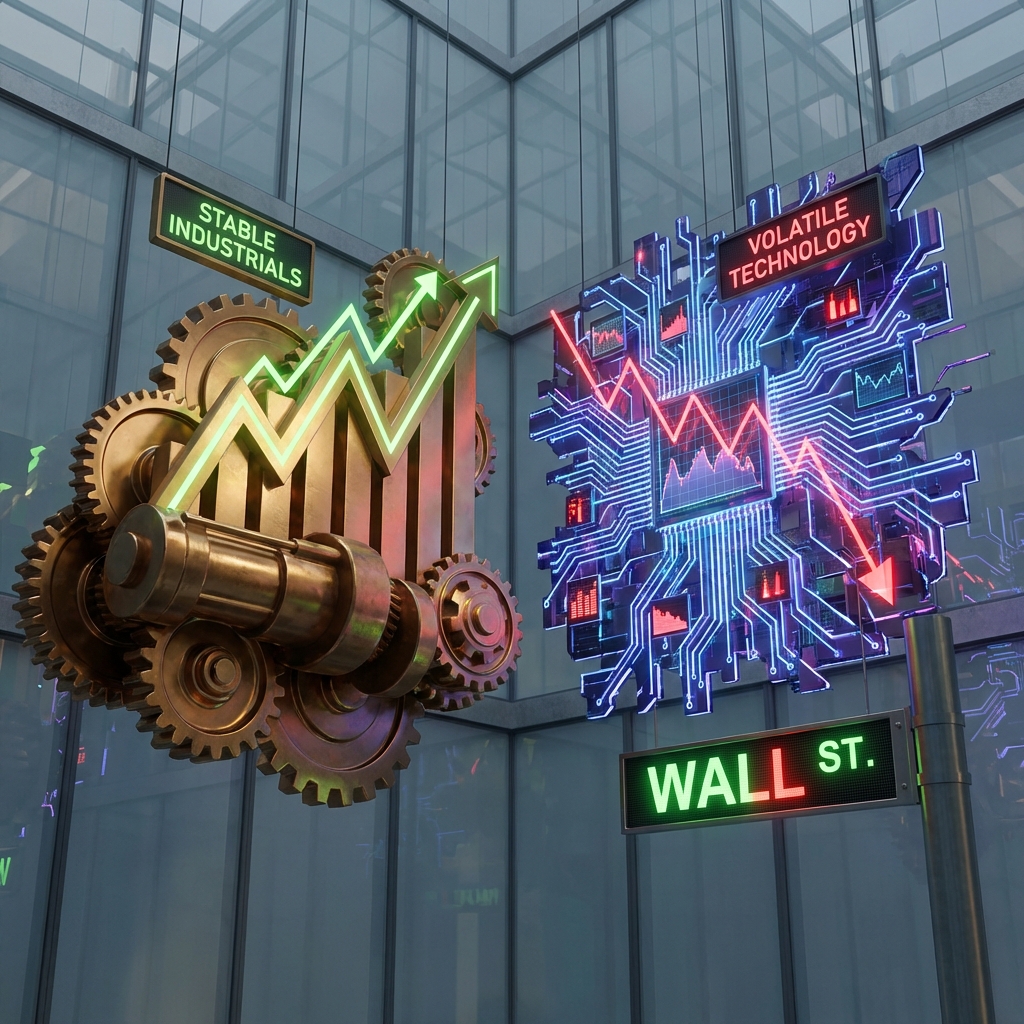
U.S. stock markets have concluded a volatile trading week with a mixed and divergent performance, as the Dow Jones Industrial Average demonstrated relative resilience while the broader S&P 500 and the technology-centric Nasdaq Composite faced notable headwinds.
This uneven market action is largely attributable to a series of disappointing corporate earnings reports from several major technology companies, which has prompted a significant reassessment of growth expectations and valuations within the sector.
Investor sentiment has palpably shifted towards a more cautious posture, influenced by a confluence of weak technology sector results, persistent geopolitical uncertainty, and shifting expectations regarding the future path of interest rates and economic growth. The divergent performance across the major indices highlights a growing schism between traditional value-oriented stocks and the growth-focused technology shares that have led the market for much of the past decade.
This dynamic raises a critical question for global investors: is the U.S. stock market entering a new, more uncertain phase after years of technology-driven gains?
Market Dynamics of the Past Week
The preceding trading week was characterized by sharp intraday swings in U.S. equities as market participants digested a significant volume of new information, including key corporate earnings reports, macroeconomic data releases, and evolving geopolitical developments.
🚨 Key Market Movements
- Dow Jones Industrial Average: Exhibited relative strength, supported by industrial, financial, and defensive stocks.
- S&P 500: Traded largely sideways, reflecting mixed performance across diverse sectors.
- Nasdaq Composite: Significantly underperformed due to weaker earnings from tech giants.
- Growth Sell-off: Disappointing results triggered a targeted sell-off in growth-oriented stocks.
The Technology Sector: A Source of Market Drag
For much of the last decade, the technology sector has been the undisputed leader of the U.S. market rally, driven by powerful secular trends such as the adoption of cloud computing, the rise of artificial intelligence (AI), the expansion of e-commerce, and the proliferation of digital services. However, the sector is now confronting a series of challenges that are tempering investor optimism.
Slowing Earnings Growth and Cautious Guidance
Several major technology companies reported earnings that, while still positive, failed to meet the market's high expectations. Even more importantly, their forward-looking guidance for the coming quarters was cautious, signaling that the period of hyper-growth may be moderating. In a market where high expectations are already priced in, even minor disappointments can trigger significant negative price reactions.
Elevated Valuation Concerns
Technology stocks have historically traded at premium valuations (e.g., higher price-to-earnings ratios) compared to more traditional, value-oriented sectors. This premium is justified by expectations of superior future growth. When that growth trajectory is called into question, or when the broader economic environment becomes more uncertain, investors begin to reassess the premium they are willing to pay for future profits.
Heightened Sensitivity to Interest Rates
Growth stocks are, by their nature, "long-duration" assets, meaning that a large portion of their current market value is derived from profits that are expected to be generated far in the future. In a higher interest rate environment, the present value of these distant future earnings is reduced (due to a higher discount rate). This mathematical reality makes the technology sector particularly vulnerable during periods of monetary policy uncertainty.
The Influence of Geopolitical and Macroeconomic Uncertainty
Beyond company-specific earnings, broader macroeconomic and geopolitical risks are also contributing to the current cautious market sentiment.
Geopolitical Risk: Ongoing global tensions involving major powers, persistent trade disputes, and the risk of regional conflicts have increased uncertainty surrounding the stability of global supply chains, energy markets, and overall economic activity.
Monetary Policy Uncertainty: The future path of monetary policy remains one of the most significant drivers of market volatility. Investors are currently attempting to decipher conflicting signals regarding interest rate cuts, inflation trajectory, and economic resilience.
Sectoral Performance: A Divergent Picture
The recent market action has not been monolithic, with clear divergences emerging across different sectors of the economy.
- Outperformers: Industrial and financial stocks have shown relative strength.
- Mixed Performers: Energy stocks influenced by oil volatility; consumer stocks reflecting mixed spending signals.
- Underperformers: Technology and high-growth stocks lagging due to earnings and valuation concerns.
This sector rotation is a classic sign of a market that is becoming more discerning and risk-aware. Instead of a broad "risk-on" or "risk-off" sentiment, investors are becoming more selective, favoring companies with stable cash flows and reasonable valuations over those with more speculative growth stories.
Conclusion: A Market at a Crossroads
The recent volatility and sector divergence on Wall Street are more than just a week of unsettled trading. They reflect a market that is at a fundamental crossroads, grappling with deeper questions about the sustainability of growth, the future path of interest rates, the impact of geopolitics, and the durability of the technology-driven market gains of the past several years.
The relative strength of the Dow Jones compared to the weakness in the Nasdaq indicates that a significant reassessment of risk and a reallocation of capital are underway, rather than a wholesale abandonment of the equity asset class.
Volatility, in this context, is not a signal of panic. It is a signal of transition. The market is moving from a phase of broad, nearly uniform optimism to one of selective confidence. Whether this transition resolves into a broader market correction, a prolonged period of sideways consolidation, or a renewed, more narrowly-focused rally will depend on the evolution of corporate earnings, central bank policy decisions, and the global geopolitical situation in the months ahead.
Disclaimer: This article is for informational and educational purposes only and does not constitute financial or investment advice.