When Markets Look Calm but Households Are Under Stress — Why This Gap Matters
Updated January 2026
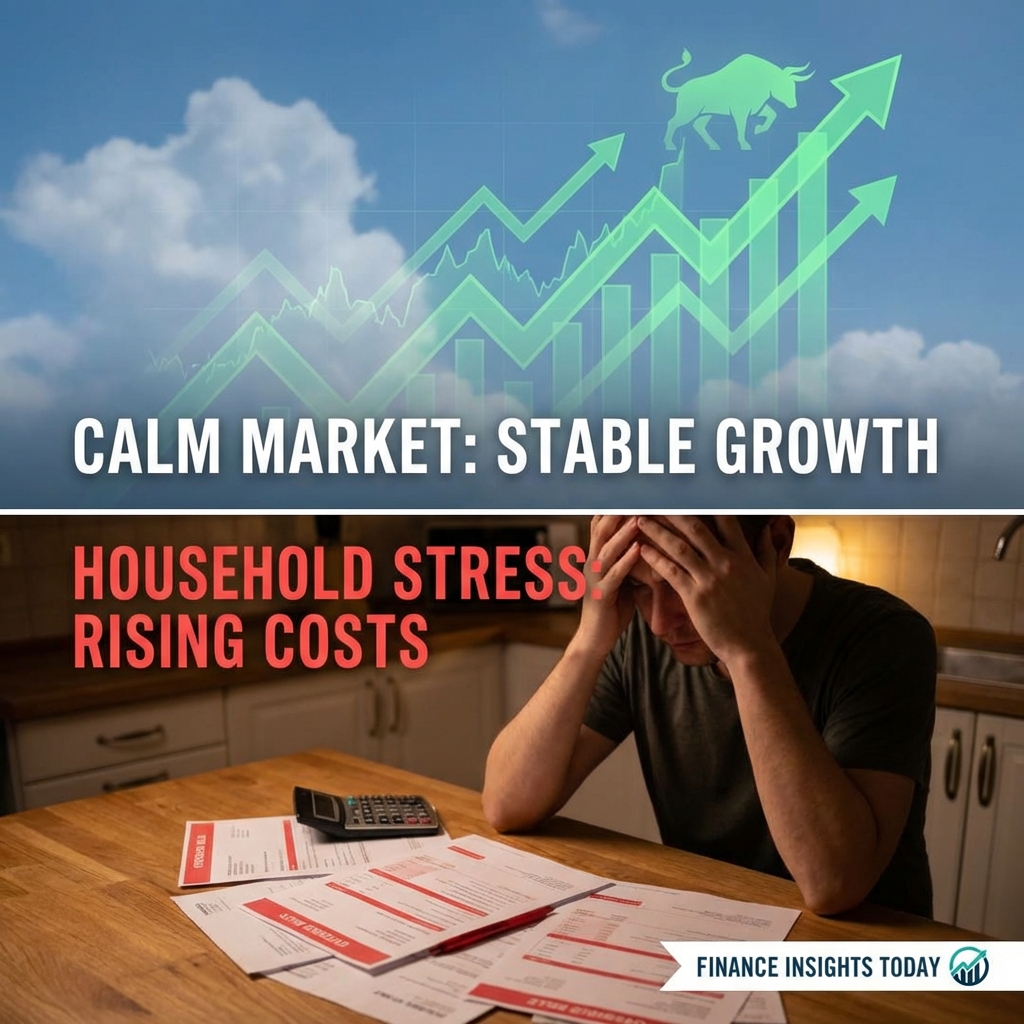
There is a profound and widening disconnect at the heart of the modern economy. Financial markets and the households that form their foundation are beginning to tell two very different stories.
Markets don't feel stress the way people do. Stock indices are driven by forward-looking expectations and corporate profit forecasts. News headlines are shaped by compelling narratives. Central banks formulate policy based on complex economic models. Households, however, operate on the unyielding basis of reality.
Right now, that gap between the financial narrative and the lived experience is growing wider. History has consistently shown that when the perceived health of financial markets and the actual financial condition of households drift too far apart, an adjustment is inevitable. Something, eventually, has to give.
This analysis will explore why markets can remain remarkably calm—even buoyant—while households are quietly struggling under mounting financial pressure. It will examine why this disconnect often persists for longer than seems logical, and why its importance tends to be recognized only after it is too late to ignore.
A Quiet and Dangerous Divide Is Forming
On the surface, and viewed from a macroeconomic altitude, global financial markets appear stable, if not outright optimistic. Major equity indices remain elevated, not far from their all-time highs. Market volatility, a key gauge of investor fear, appears contained and subdued. The headline economic data, for the most part, continues to point towards resilience and modest growth rather than an imminent contraction. From a distance, the system looks healthy.
But beneath that calm surface, at the microeconomic level of the individual household, a very different and more troubling picture is emerging. Financial pressure is steadily and undeniably increasing.
📉 The Household Reality Check
- Credit card balances are climbing to record levels.
- Minimum monthly payments are rising in lockstep with higher interest rates.
- Household savings buffers, painstakingly built up during the pandemic, are shrinking or, for many, have been completely exhausted.
- A growing number of families are relying on short-term, high-interest debt not for discretionary luxuries, but to cover essential, everyday expenses like groceries and fuel.
These two starkly different realities can, and often do, coexist for a prolonged period. But they cannot coexist forever. At some point, the fundamental difference between what the market believes and what the average household is experiencing begins to matter immensely.
Why Markets Can Ignore Household Stress for So Long
Financial markets do not measure comfort or hardship; they measure probability and future expectations. There are several powerful, structural reasons why asset prices can remain calm, and even rise, at the same time as households feel an intensifying squeeze.
Markets Are Forward-Looking, Not Present-Looking
Investors and algorithms price assets based on what they expect to happen six to twelve months in the future, not what is happening today. As long as corporate earnings forecasts remain positive and the dominant economic models predict a "soft landing" or continued stability, markets have little incentive to react to the early, lagging indicators of household stress.
Index Concentration Masks Broad Weakness
Modern stock market indices, like the S&P 500, are heavily dominated by a small number of mega-cap companies. The spectacular performance of a handful of giant technology and multinational firms can easily lift the entire index, creating the illusion of broad market strength even if the majority of smaller, more domestically-focused companies are struggling alongside their customers. The weakness among average households may simply not show up in the headline stock market figures.
Corporate Profits Lag Household Pressure
There is a significant time lag between when consumers feel financial strain and when it shows up in corporate profit and loss statements. Businesses have a range of tools to absorb initial shocks. They can raise prices, cut operational costs, invest in automation, and adjust their marketing strategies long before their earnings begin to suffer in a meaningful way. Households, by contrast, have far fewer options when their budgets are squeezed.
The Power of Liquidity
As long as a river of capital continues to flow into the market—from institutional investors like pension funds, mandatory retirement savings, and global capital seeking a safe haven—asset prices can remain elevated and even drift higher, even when the underlying economic fundamentals are clearly softening. Liquidity can hide a multitude of sins, at least for a while.
The Uneven Nature of Household Stress
Financial pressure is not a uniform event; it rarely hits everyone at once. Lower- and middle-income households, who have smaller savings buffers and are more exposed to inflation in essential goods, tend to feel the squeeze first and most acutely. Higher-income groups, who own the majority of financial assets, often remain relatively insulated for much longer. Because markets primarily reflect aggregate corporate performance, which is often driven by the spending of higher-income consumers, they can remain detached from the hardship experienced by a large portion of the population.
For all these reasons, financial markets can appear serene and untroubled while everyday economic life becomes progressively more difficult for millions of people.
The Turning Point: The Role of Debt in Masking and Magnifying the Gap
Debt is a mechanism that stretches time. It allows households to maintain their level of consumption and their standard of living even as their real incomes are falling and financial pressure is rising—at least, temporarily.
Credit cards, buy-now-pay-later (BNPL) plans, and personal loans act as a shock absorber. They smooth out the immediate impact of higher costs and create the illusion that everything is still manageable. But debt does not remove the underlying pressure; it simply concentrates it and defers it into the future.
As credit card balances rise and high interest rates begin to compound, a household's financial flexibility inexorably shrinks. What once felt like a manageable monthly payment slowly but surely transforms into a heavy and suffocating burden. The room for error disappears.
When Buffer Becomes Burden
Eventually, the cycle reaches a turning point. This often occurs when credit availability tightens. As banks observe rising delinquency rates and become more concerned about the economic outlook, they begin to pull back on lending. They raise their approval standards, lower credit limits, and become more cautious.
This is the moment the temporary buffer of easy credit disappears. It is the moment that households can no longer easily borrow to fill the gap between their income and their expenses. And it is the moment that the disconnect between the calm of the market and the harsh reality of household finances begins to close, often with surprising speed.
Why and How the Disconnect Eventually Closes
The gap between market perception and household reality does not close because markets suddenly develop a social conscience and begin to "care" about the struggles of the average person. It closes for a much more pragmatic and unavoidable reason: household behavior eventually and inevitably affects corporate earnings, economic growth, and financial risk.
Historically, this adjustment process tends to follow a familiar and logical path:
🔄 The Adjustment Cycle
- As their financial situation deteriorates, households are forced to cut back on discretionary spending—the "wants," not the "needs." They eat out less, cancel subscriptions, and postpone major purchases like a new car or a vacation.
- This leads to slowing revenue growth for a wide range of consumer-facing businesses.
- As revenues slow, corporate earnings expectations are adjusted downward.
- Observing this trend, banks and lenders tighten their credit conditions further, making it even harder for both consumers and businesses to borrow.
- This confluence of negative data causes market sentiment to shift decisively from optimism to caution, leading to a re-pricing of risk and a correction in asset prices.
The key insight here is one of timing. Markets are a lagging indicator of household stress. They rarely react to the early, quiet signs of trouble. They react when the stress becomes so widespread and significant that it is impossible to ignore in the official economic data and corporate earnings reports. By the time that happens, the shift in market sentiment often feels sudden and shocking, even though the underlying pressure has been building quietly for many months.
Conclusion: The Economy Turns on Limits, Not Headlines
Markets are remarkably efficient at pricing in optimism and hope. Households are brutally efficient at absorbing the hard realities of their financial situation. When these two perceptions drift too far apart, history suggests that an adjustment will follow—not because of a single, dramatic event or a sudden panic, but because the cumulative effect of millions of individual behavioral changes eventually becomes an undeniable macroeconomic force.
The economy does not turn on headlines. It turns on limits. And right now, in the quiet of their own homes, millions of households are beginning to discover where theirs are. Ignoring this widening gap does not make it disappear. But recognizing it early is the first and most critical step in making sound and resilient financial decisions in an increasingly uncertain world.
Disclaimer: This article is for informational and educational purposes only and does not constitute financial or investment advice.