U.S. Stock Market Reaches Record Highs: What’s Driving the Rally and What It Means for Investors
INTRODUCTION: A MARKET THAT CONTINUES TO DEFY GRAVITY
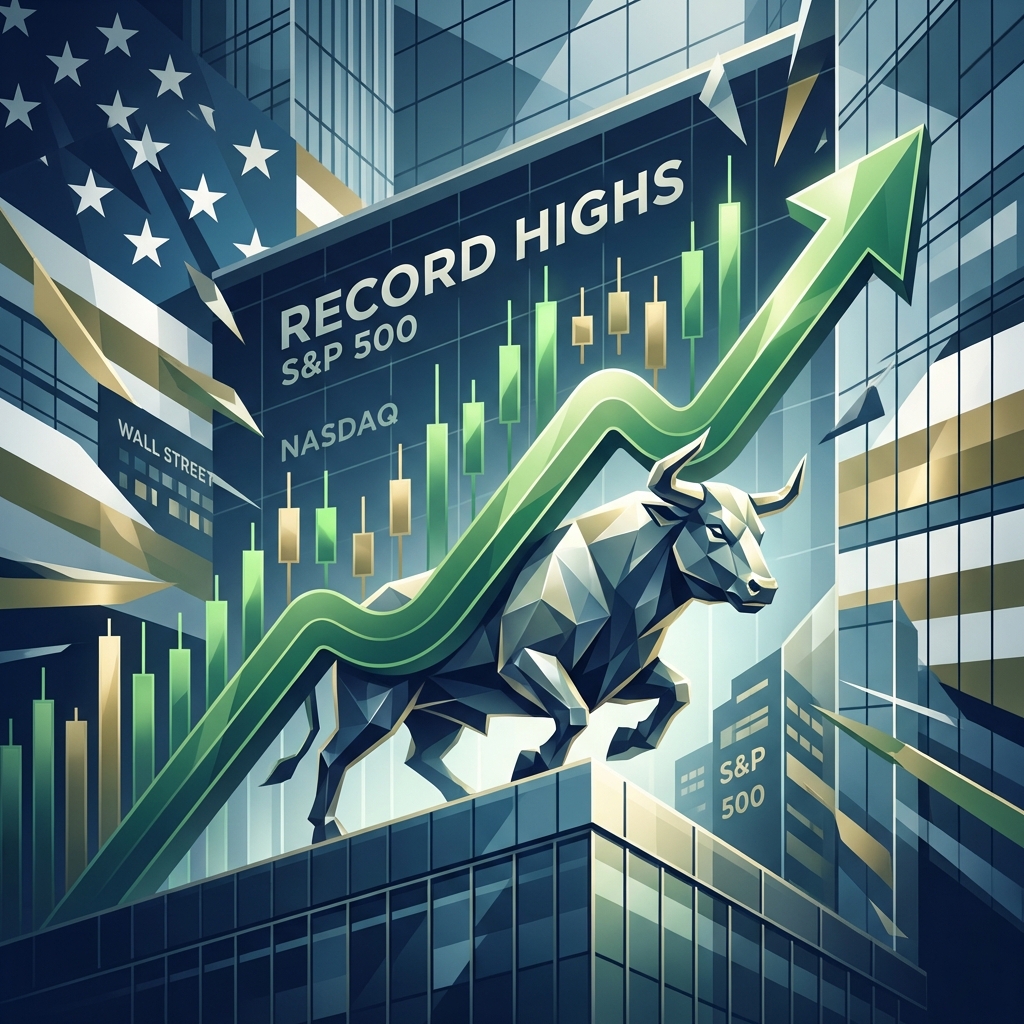
The U.S. stock market has once again ascended to new, historic heights, with the major indices—the Dow Jones Industrial Average, the S&P 500, and the technology-heavy Nasdaq Composite—climbing decisively beyond their previous peaks. For many investors, this milestone is a source of both profound optimism and a quiet, nagging sense of unease. On one hand, record highs are a powerful signal of economic strength, corporate resilience, and investor confidence. On the other, they invariably raise uncomfortable questions about stretched valuations, the potential for speculative bubbles, and the ever-present risk of a sudden and sharp market correction.
It is important to note that, in a fundamentally growing economy, market highs are not an anomaly; they are a natural and expected occurrence. Over long periods, markets are supposed to move upward as companies innovate, populations expand, and productivity improves, driving earnings and, by extension, stock prices higher.
However, what makes the current situation particularly notable and worthy of deep analysis is the complex and often contradictory environment in which these records are being set. The market's ascent is occurring alongside a backdrop of persistent economic uncertainty, including stubborn inflationary pressures, the highest interest rates in over a decade, escalating geopolitical tensions, and a concerning rise in consumer debt.
This analysis will explore the powerful forces that are driving the current market rally, examine the underlying risks that may be lurking beneath the surface, and discuss how different types of investors are navigating this challenging and emotionally charged environment.
Deconstructing the Headline: What Does a "Record High" Actually Mean?
When the financial news trumpets that the "stock market is at a record high," it is referring to a specific market index surpassing its previous all-time peak closing value. The three most-watched indices in the U.S. are:
- The Dow Jones Industrial Average, which tracks the performance of 30 large, well-established industrial companies.
- The S&P 500, which is a much broader measure, tracking 500 of the largest publicly traded U.S. companies and representing about 80% of the total U.S. market value.
- The Nasdaq Composite, which is heavily weighted toward the innovative and often more volatile technology and growth sectors.
A record high simply means that the combined, market-cap-weighted value of the companies within that index is higher than it has ever been before. It is a statement of historical fact. Crucially, a record high does not automatically mean that stocks are overvalued or in a "bubble." It only means that they are being valued more highly today than at any point in the past.
The context, however, is everything. A market that rises steadily in lockstep with strong and accelerating corporate earnings growth is fundamentally different from a market that surges due to speculative fervor, a flood of "easy money" from central banks, or an excess of irrational optimism. Understanding the drivers of the current rally is therefore essential to assessing its durability.
The Engines of the Rally: What Is Pushing U.S. Stocks Higher?
Several powerful and interconnected forces are currently acting as the primary engines of this market ascent.
Despite the headwinds of high interest rates and persistent inflation, a large segment of corporate America has demonstrated remarkable resilience and continues to deliver strong and, in many cases, better-than-expected profits. Many U.S. companies have successfully adapted to the new economic environment by:
- Exercising Pricing Power: Raising prices to offset higher input costs.
- Improving Efficiency: Cutting costs and investing in automation and technology to protect profit margins.
- Diversifying Supply Chains: Reducing their vulnerability to geopolitical disruptions.
The technology, healthcare, and consumer service sectors have been particularly robust. This ongoing earnings stability provides a fundamental justification for the rally, reassuring investors that higher stock prices are not entirely detached from underlying economic reality.
Financial markets are, at their core, forward-looking discount mechanisms. They do not just react to what is happening today; they trade on expectations of what will happen tomorrow. Even before a central bank like the Federal Reserve actually begins to cut interest rates, the mere expectation that it will do so is a powerful catalyst for asset prices.
Lower interest rates are a potent fuel for stock markets. They reduce borrowing costs for companies, which encourages new investment. They also make future corporate profits more valuable in today's terms (by lowering the discount rate in valuation models). As a growing number of investors begin to anticipate an eventual "pivot" to easier monetary policy, they are strategically shifting capital into equities to position themselves ahead of the curve.
In a world of increasing geopolitical and economic uncertainty, the United States remains the world's largest, deepest, and most trusted financial market. During periods of instability in other parts of the world, global investors often choose U.S. stocks and bonds as a relative safe haven. The U.S. market's reputation for political stability, strong legal protections for property rights, corporate transparency, and unparalleled liquidity makes it an attractive destination for international capital seeking safety and growth.
The rapid advancements in artificial intelligence (AI), alongside the continued growth of cloud computing, automation, and digital infrastructure, have created a powerful and compelling secular growth story. There is a widespread belief among investors that these technologies will unlock a new wave of productivity gains, reduce costs across all industries, and create entirely new markets. This profound optimism has driven massive capital inflows into a handful of large-cap technology stocks, and because these companies make up a significant portion of the major indices, their spectacular performance has had the effect of lifting the entire market higher.
The Unseen Dangers: Risks Beneath the Surface of the Rally
While the drivers of the rally are clear, it is crucial to acknowledge the significant risks that could disrupt the market's upward momentum.
- A Resurgence of Inflation: If inflation proves to be more "sticky" than expected or if a new shock (like a spike in energy prices) causes it to re-accelerate, central banks could be forced to abandon their plans for rate cuts and may even have to tighten policy further. This would be a major negative catalyst for stocks.
- A Sharp Economic Slowdown: The full impact of the past two years of high interest rates may not have been felt yet. A sharp deterioration in the labor market or a sudden drop in consumer spending could lead to a recession, which would negatively impact corporate earnings and investor sentiment.
- Rising Consumer Stress: The combination of high consumer debt levels and rising delinquency rates on credit cards and auto loans is a significant vulnerability. A wave of consumer defaults could create stress in the banking system and weigh on economic growth.
- Geopolitical Shocks: The market is currently operating in a fragile geopolitical environment. A major escalation of a conflict or a new trade disruption could trigger a sudden flight to safety and a sharp correction in equity markets.
In summary, the market is not necessarily in a bubble, but it is priced for a high degree of optimism and may be vulnerable to any negative surprises.
Navigating the Heights: How Different Investors Are Responding
- Long-Term, Disciplined Investors: These investors are generally advised to stay invested, as market history shows that trying to time the top is a fool's errand. Their focus is on rebalancing their portfolios (selling some of their winners to buy assets that have underperformed) and avoiding emotional, headline-driven decisions.
- Retail Investors: This group is often split. Some are driven by a "fear of missing out" (FOMO) and are chasing the momentum, while a more cautious cohort is waiting on the sidelines, fearful of buying at the top.
- Institutional Investors: Large institutions like pension funds and mutual funds are taking a more nuanced approach. They are actively hedging their risks using options and other derivatives, rotating capital between different sectors of the economy, and carefully managing their exposure to the most expensive parts of the market.
- Short-Term Traders: Traders are focused on the increased volatility. They are using the sharp daily price movements to generate short-term profits, without necessarily taking a long-term view on the market's direction.
Final Thoughts: A Signal of Both Strength and Fragility
The U.S. stock market's ascent to new record highs is a powerful testament to the resilience of the American economy, the innovative power of its leading companies, and the enduring global confidence in its financial markets. It reflects real and tangible strengths.
However, these record highs also reflect a significant degree of hope and are occurring in an environment fraught with risk and uncertainty. They are a double-edged signal, representing both strength and a certain fragility.
For the prudent investor, a record high is neither a signal to panic-sell nor a signal to greedily pile in. It is a signal that demands careful interpretation and a recommitment to the timeless principles of investing: discipline, diversification, and a long-term perspective. The most successful investors in this environment will be those who can appreciate the rally's strengths without becoming blind to its underlying vulnerabilities.