Markets Look Strong — But Households Are Under Pressure
INTRODUCTION: A TALE OF TWO ECONOMIC REALITIES
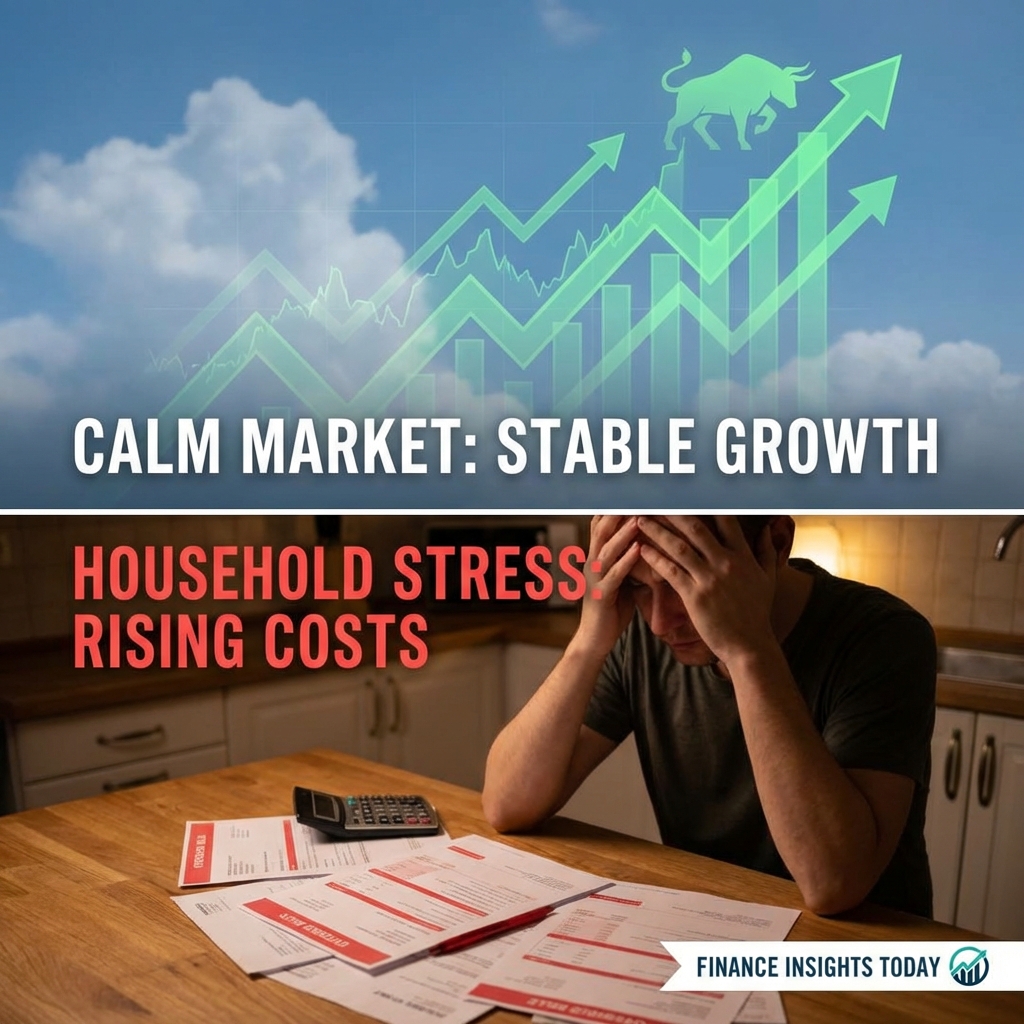
A significant and growing divergence is emerging between the performance of institutional financial markets and the economic condition of individual households. Major equity indices remain elevated, official economic data continues to indicate resilience, and expert forecasts often emphasize stability. Concurrently, however, a substantial portion of the population is experiencing mounting financial pressure, characterized by rising credit card balances, diminished savings, and an increasing reliance on debt to finance essential expenditures.
This disconnect—between ostensibly calm institutional markets and stressed household balance sheets—is not an unprecedented phenomenon. However, historical analysis suggests that when such a divergence becomes pronounced and prolonged, it is an inherently unstable condition. An adjustment is typically inevitable.
This analysis will examine the structural reasons why financial markets can remain insulated from household financial stress in the short to medium term, why this gap often persists longer than anticipated, and the mechanisms through which it ultimately resolves, often with significant market implications.
The Manifestation of the Divergence
From a macroeconomic perspective, the financial system currently appears stable, if not optimistic. Major equity indices are trading near historic highs, implied market volatility is relatively contained, and aggregate economic data continues to point towards positive growth rather than a contraction.
However, a granular examination of household-level data reveals a contrasting and more concerning narrative. The cumulative impact of inflation has reshaped household budgets, with the cost of non-discretionary items such as food, rent, insurance, and healthcare rising significantly. In response, many households are not in a state of acute crisis, but they are financially stretched, exhibiting behaviors indicative of rising strain:
📉 Indicators of Household Strain
- An increase in revolving credit card debt.
- A decline in personal savings rates.
- A greater reliance on short-term credit to manage month-to-month cash flow shortfalls.
This creates two parallel but divergent economic realities:
Characterized by stability, driven by forward-looking data models and institutional capital flows.
Characterized by immediate, personal financial constraints and rising budgetary pressures.
While these two realities can coexist, they cannot remain disconnected indefinitely.
Structural Factors Masking Household Financial Stress in Market Prices
Financial markets are not designed to measure social comfort; they are designed to discount future probabilities. Several structural factors explain why asset prices can remain elevated even as the financial health of a large segment of the population deteriorates.
Equity prices are a function of investors' expectations regarding future corporate earnings, economic growth, and monetary policy. As long as these forward-looking indicators and models remain positive, markets have a rational basis for remaining elevated, even if current household conditions are strained.
Modern market indices, such as the S&P 500, are market-capitalization weighted and are therefore heavily influenced by the performance of a small number of mega-cap companies. The strong performance of a handful of large technology or multinational corporations can lift the entire index, masking underlying weakness in smaller, more domestically-focused firms that are more sensitive to the spending patterns of the average consumer.
There is a significant lag between the onset of household financial pressure and its manifestation in corporate earnings reports. Businesses can often mitigate the initial impact by passing higher costs on to consumers, thereby protecting their profit margins in the short term.
The flow of institutional capital—from pension funds, sovereign wealth funds, and global investors—can be a powerful force that supports asset prices, even if the underlying economic fundamentals are softening. As long as this liquidity remains abundant, it can mask the growing fragility of the system.
The impact of inflation and high interest rates is not distributed evenly. Lower- and middle-income households, who spend a larger proportion of their income on essential goods and have smaller savings buffers, experience financial pressure first. Higher-income households, who own the majority of financial assets, often remain insulated and may even benefit from certain aspects of the economic environment. Because aggregate corporate performance is often disproportionately driven by the spending of higher-income cohorts, the market can appear healthy even as a majority of the population experiences hardship.
The Mechanism of Adjustment: How the Gap Eventually Closes
The divergence between market sentiment and household reality does not resolve because markets suddenly develop a concern for social welfare. It closes for a more fundamental and mechanical reason: the cumulative effect of changes in household behavior eventually becomes a macroeconomic force that impacts corporate earnings, economic growth, and financial risk.
This adjustment process typically unfolds in a sequential manner:
🔄 The Adjustment Sequence
- Contraction in Discretionary Spending: As household budgets tighten, the first casualty is discretionary spending on non-essential goods and services.
- Deceleration in Corporate Revenue: This leads to a slowdown in revenue growth for a wide range of consumer-facing businesses.
- Downward Revision of Earnings Expectations: As revenue growth falters, corporate earnings forecasts are revised downwards by market analysts.
- Tightening of Credit Conditions: Observing the slowdown and rising delinquencies, banks and other lenders begin to tighten their underwriting standards, making it more difficult for both consumers and businesses to obtain credit.
- Shift in Investor Sentiment: The confluence of these negative data points causes a decisive shift in investor sentiment from optimism to caution, leading to a re-pricing of risk and a correction in asset prices.
The key insight is one of timing. Markets are a lagging indicator of household financial stress. They do not react to the initial, quiet signs of pressure. They react when that pressure has built to a point where it is undeniably visible in the hard economic data.
The Peril of Misinterpretation
This stage of the economic cycle is often misinterpreted because the primary economic signals appear to be in conflict.
- Market Signals: Asset prices are stable or rising, suggesting low risk.
- Household Signals: Financial conditions are tightening, suggesting high risk.
The analytical error is to assume that either calm prices mean low risk or that rising household stress guarantees an immediate crisis. Neither assumption is accurate. This phase is not necessarily about an impending collapse, but about a significant increase in systemic vulnerability. As the financial margins for error for millions of households shrink, the entire economic system becomes more sensitive and less resilient to any new, unexpected shock—whether it is a policy mistake, a geopolitical event, or a sudden spike in a key commodity price.
Conclusion: The Inevitability of Mean Reversion
The current disconnect between the apparent health of financial markets and the lived financial reality of many households reflects a deeper truth about modern economies: asset prices are driven by institutional capital flows and forward-looking expectations, while living standards are driven by the immediate relationship between prices and wages.
When these two metrics diverge for a prolonged period, social and economic tensions inevitably rise. Trust in institutions can erode, and political pressure for policy intervention increases. The system does not break because people feel stressed; it becomes fragile because human behavior changes under that stress. The economy does not ultimately turn on headlines or forecasts. It turns on the hard constraints and limits faced by its constituent parts. And at present, a growing number of households are quietly discovering where those limits are.