Gold and Silver Surge as Global Risks Rise — What the Precious Metals Rally Signals About the World Economy
Introduction: A Barometer of Anxiety
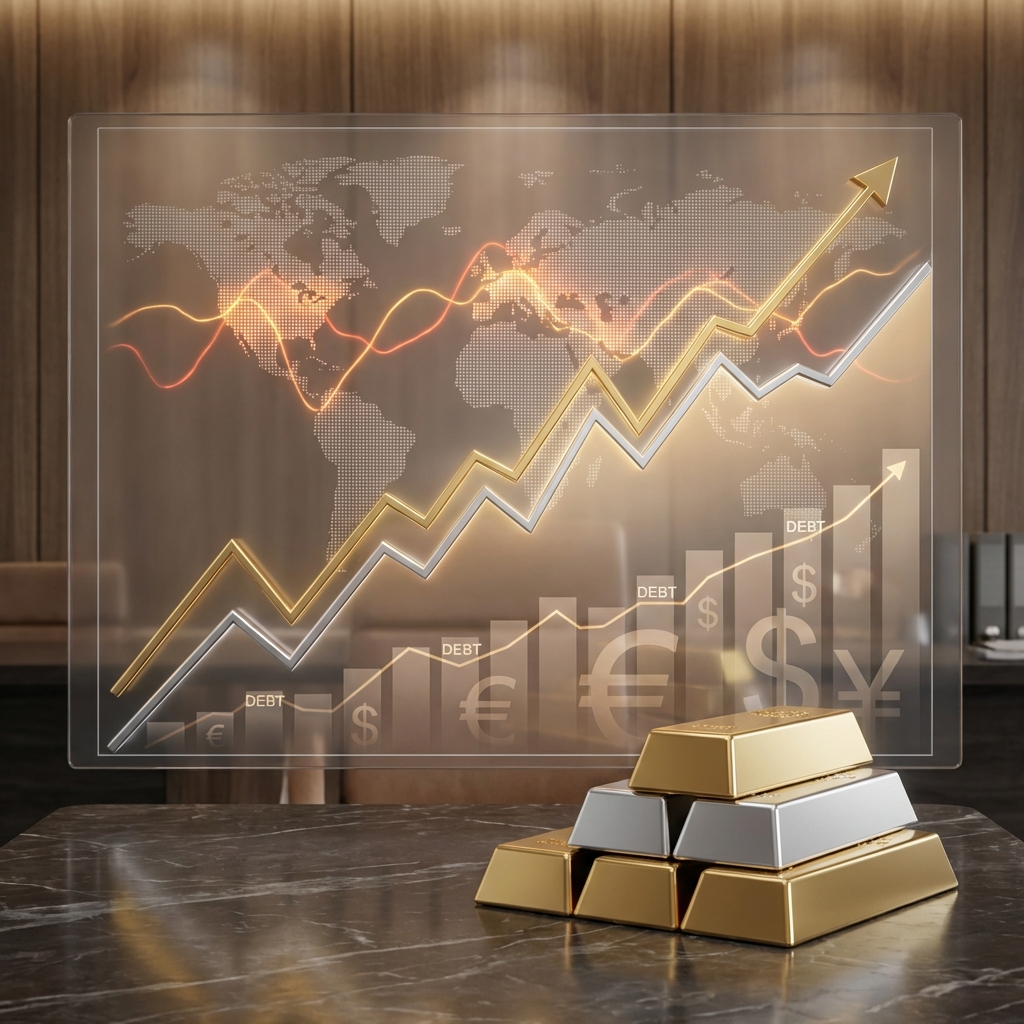
Over the past few months, a quiet but unmistakable signal has been flashing across global financial markets. Gold has been making a steady, determined climb. Silver has been swinging higher with increasing and noticeable momentum. While this has been happening, the mood in the markets for stocks, bonds, and currencies has become more cautious and uncertain.
This is not a random price fluctuation. It is the reflection of a deep and growing shift in how investors around the world are thinking about risk, stability, and the future of the global economy. When precious metals start to attract this much attention, it usually sends one clear message: confidence in the smooth and predictable functioning of the traditional financial system is beginning to weaken.
This surge in gold and silver isn't just a story about commodities. It is a powerful reflection of a deeper, underlying anxiety in the global financial system, a sign that the ground beneath our feet may be less solid than it appears.
Why Are Investors Buying Gold and Silver Now? A Cocktail of Fear
The current rally in precious metals is not being driven by a single issue, but by a potent and converging "cocktail" of four major global concerns.
Four Key Drivers of the Rally
- Geopolitical Fear: Return of great-power rivalries and conflicts
- Mounting Debt: Unprecedented global government debt levels
- Monetary Uncertainty: Unclear future path for interest rates
- Currency Distrust: Fading confidence in fiat money systems
1. The Return of Geopolitical Fear
For a long time, investors could largely ignore geopolitics. That is no longer the case. A landscape of increasing global conflicts and great-power rivalries is creating a pervasive sense of uncertainty. Wars, sanctions, and trade disputes are no longer just headlines; they are real-world events that are disrupting global supply chains, roiling energy markets, and making the future of global trade far less predictable.
During these periods of high geopolitical stress, investors naturally de-risk. They reduce their exposure to assets that are tied to global growth, like stocks and the currencies of emerging markets, and they increase their holdings in assets that are seen as neutral and safe. Gold and silver are the ultimate neutral assets—their value is not tied to any single government, political system, or alliance.
2. The Mountain of Global Debt
Global government debt has climbed to unprecedented, almost unimaginable levels. Many of the world's most important countries are running huge budget deficits, and they are doing so at a time when interest rates are much higher than they have been for the past decade.
This massive and growing pile of debt is fueling deep-seated fears of:
- Future Inflation: The worry that governments may be forced to "print money" to pay off their debts, which would devalue their currencies.
- Financial Instability: The risk that the debt burden itself could become unsustainable, leading to a financial crisis.
- Higher Taxes in the Future: The recognition that this debt will eventually have to be paid back, likely through higher taxes that could weigh on future economic growth.
In this environment, gold is often seen as the ultimate form of financial insurance against government mismanagement. When investors worry that a country is losing control of its finances, the demand for gold as a non-sovereign store of value naturally increases.
3. The Puzzle of Interest Rates
The world's central banks, like the U.S. Federal Reserve, are in a very tricky position. On one hand, some parts of the economy are slowing down, which would normally be a reason to cut interest rates. On the other hand, inflation remains stubbornly high. This has created a huge amount of uncertainty about the future path of monetary policy.
Gold and silver typically benefit from this kind of uncertainty, and they perform especially well when investors expect interest rates to fall. Lower interest rates reduce the "opportunity cost" of holding a non-yielding asset like gold. In simple terms, when the interest earned on cash in the bank is low, the appeal of holding a tangible asset like gold, which pays no interest but offers safety and upside, becomes much greater.
4. The Fading Trust in Paper Money
Ultimately, the price of precious metals is a reflection of the public's confidence in "fiat" or paper currencies. When investors lose faith in the long-term stability of the dollar, the euro, or the yen, they naturally seek out alternatives that cannot be created out of thin air by a government. Gold has served this role as a reliable store of value for thousands of years, across dozens of civilizations, making it the natural hedge against currency instability. Silver, while more volatile, tends to follow gold's lead during these periods of monetary uncertainty.
What the Gold and Silver Rally Is Really Signaling to the World
Gold is often called the "fear gauge" of the financial markets. When the price of gold and silver rises sharply and consistently, it is usually a powerful signal of several underlying concerns:
- A rise in systemic risk—the fear that the entire financial system is becoming more fragile.
- Growing uncertainty about future economic growth.
- Widespread expectations of easier monetary policy (i.e., that central banks will soon start cutting rates or printing money).
- A weakening of confidence in the ability of governments and central banks to manage their finances.
The current rally is significant because it suggests that investors are not just hedging against one of these risks, but against all of them at the same time—geopolitical, financial, and macroeconomic.
Why Gold and Silver Are Rising Together, But Behave Differently
While they are often grouped together, gold and silver are two very different players on the same team.
Gold: The Ultimate Financial Safe Haven
Gold is primarily a financial asset. It is bought and held by the world's most conservative and long-term-oriented investors:
- Central banks, to protect their national wealth.
- Large institutional investors, as a portfolio diversifier.
- Long-term savers, as a hedge against inflation and crisis.
Gold is the ultimate defensive asset.
Silver: The Hybrid Metal
Silver, on the other hand, is a hybrid. It is part safe-haven asset and part critical industrial metal. It is a key, non-substitutable ingredient in solar panels, electric vehicles, and all forms of electronics.
This dual role makes silver much more volatile. It can be hit hard during a recession when industrial demand falls, but it can also dramatically outperform gold during an economic recovery or an inflationary period when both investment and industrial demand are strong.
When both metals are rising together, as they are now, it is often a sign of broad macroeconomic uncertainty, where investors are looking for protection but are also anticipating future inflation.
What This Means for Investors and the Broader Market
The renewed interest in precious metals is not happening in a vacuum; it has real-world implications for other asset classes.
- For the Stock Market: A strong rally in gold can be a warning sign of rising risk aversion, which can put pressure on high-growth, speculative stocks. However, the companies that actually mine gold and silver often see their stock prices rise.
- For Currencies: A gold rally often happens at the same time as a weaker U.S. dollar and stronger safe-haven currencies like the Japanese yen and the Swiss franc.
- For the Bond Market: The same fears that drive investors to gold often drive them to the safety of government bonds, which can push bond yields lower. Falling yields are a classic signal of expectations of slower economic growth and future rate cuts.
For investors, the message is clear: the role of precious metals as a tool for diversification and portfolio insurance is becoming more important. For traders, the increased volatility presents new opportunities. For central banks, the rising price of gold may reinforce their ongoing strategy of accumulating more of it to reduce their reliance on the U.S. dollar.
Final Thoughts: A Reflection of Realism
The renewed focus on gold, silver, and the broader commodity complex is not necessarily a prediction of an imminent crisis. It is a reflection of realism. It is a sign that a growing number of market participants are acknowledging that the global economy faces a series of profound and structural challenges: high debt, persistent inflation, and a more fragmented and politically unstable world.
In such an environment, relying solely on traditional growth assets like stocks is a risky strategy. Diversification becomes essential. Stability becomes valuable. And the tangible, time-tested value of real assets becomes undeniable.
That is why precious metals are back in focus—not because the world is ending, but because the world is fundamentally changing. And in times of great change, prudent investors look for anchors. Gold provides the ultimate anchor of stability. Silver offers both an anchor and a sail for the journey ahead.
Disclaimer: This article is for informational and educational purposes only and does not constitute financial or investment advice.